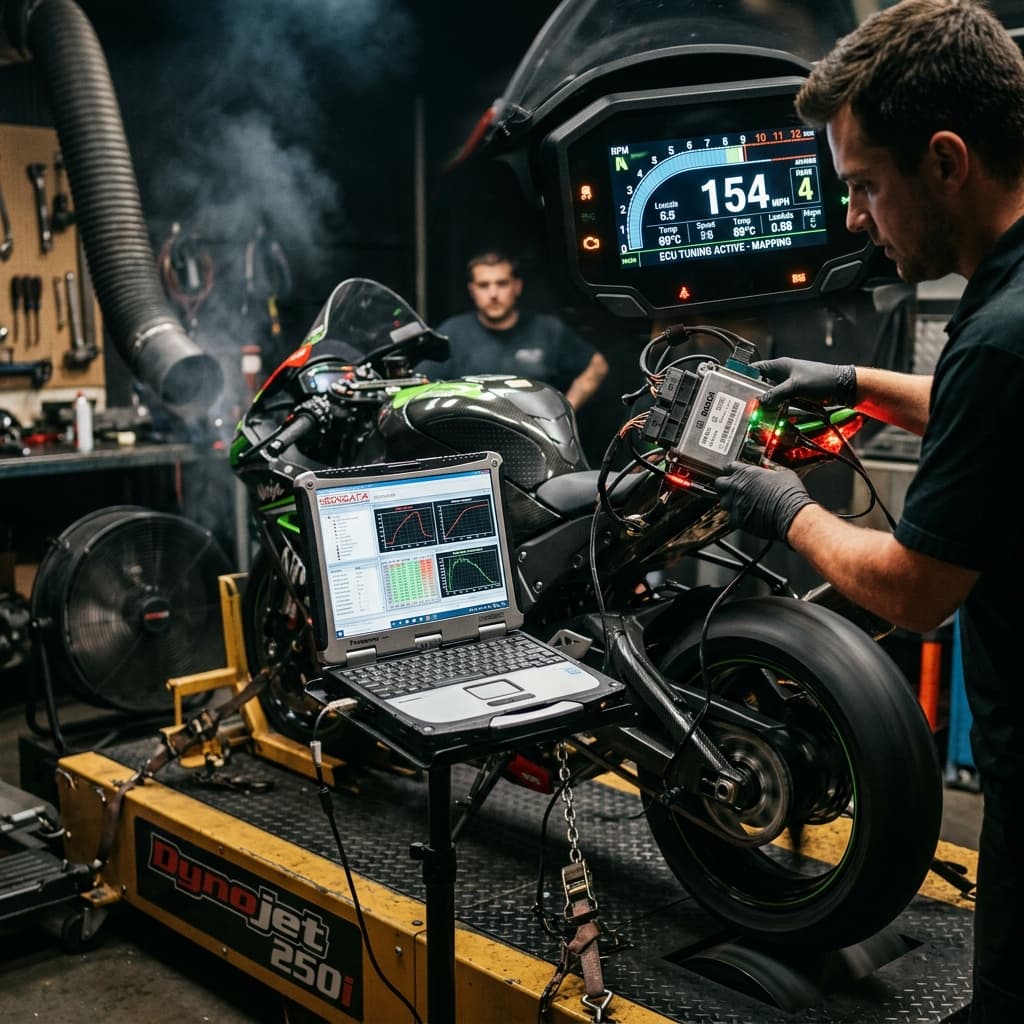
The Brain of the Beast
Modern motorcycles are completely controlled by the Engine Control Unit (ECU). The ECU determines exactly how much fuel to inject and when to fire the spark plug based on thousands of sensor readings every second.
Factory ECU maps are notoriously lean. Manufacturers run the bikes lean (less fuel, more air) to pass strict emissions testing. This often results in a jerky throttle response at low RPMs and restricted top-end power.
Why You Must Tune After an Exhaust
When you install a high-flow aftermarket exhaust or air filter, you dramatically increase the airflow through the engine. If you do not update the ECU map to add more fuel to compensate for the extra air, the engine will run dangerously lean.
Running lean causes extreme combustion temperatures, which can lead to burnt valves and engine failure over time.
Flashing vs. Piggyback Systems
A 'Piggyback' system (like a Power Commander) intercepts the signal between the ECU and the injectors, modifying it on the fly. A 'Flash' rewrites the base code inside the ECU itself.
Flashing is generally superior as it allows tuners to also remove factory top-speed limiters, adjust engine braking, lower the cooling fan activation temperature, and completely smooth out the ride-by-wire throttle response.
"An aftermarket exhaust gives the bike lungs. An ECU flash gives it the brain to use them."
Ready to Build Your Dream Bike?
Apply these concepts directly in our interactive 3D studio. Customize colors, parts, and accessories in real-time.
Start Customizing